Sainte
SYMPHOROSE, veuve de saint Gétulius (+ 10 juin 124), martyre à Tibur
(Tivoli) sous Adrien avec ses sept fils saints CRESCENT, JULIEN,
NEMESIUS, PRIMITIF, JUSTIN,, STATEE et EUGENE (vers 135).Sainte GUDDENE, vierge et martyre à Carthage sous Septime Sévère (203).
Saint MARCEL, qui accomplit son martyre en étant étendu sur un lit incandescent.
Saints martyrs DASION et MARON, morts par le glaive.

Saints PAUL, VALENTIN et THEE, natifs d'Egypte, martyrs à Dio-Césarée.
Sainte MARINE, vierge et martyre à Orense en Galice.
Saint HYACINTHE, martyr à Amastris en Paphlagonie (IVème siècle).
Saint ATHANASE, natif de Rome, martyr à Clysma (aujourd'hui Suez) sous Maximien (entre 303 et 305).
Saint MATERNIEN, évêque de Milan en Lombardie, confesseur sous Maximien (307).
Saint MARCEL, qui accomplit son martyre en étant étendu sur un lit incandescent.
Saints martyrs DASION et MARON, morts par le glaive.
Saints PAUL, VALENTIN et THEE, natifs d'Egypte, martyrs à Dio-Césarée.
Sainte MARINE, vierge et martyre à Orense en Galice.
Saint HYACINTHE, martyr à Amastris en Paphlagonie (IVème siècle).
Saint ATHANASE, natif de Rome, martyr à Clysma (aujourd'hui Suez) sous Maximien (entre 303 et 305).
Saint MATERNIEN, évêque de Milan en Lombardie, confesseur sous Maximien (307).

Saint EMILIEN, martyr à Durostorum (aujourd'hui Silistra, sur la frontière roumano-bulgare) sous Julien l'Apostat (362). (Office traduit en français par le père Denis Guillaume au tome VII des Ménées.)
Ai tempi del tentativo di restaurazione pagana di Giuliano l'Apostata,
un emissario imperiale di nome Capitolino si recò in Mesia per
assicurarsi che gli ordini dell'Imperatore in materia religiosa
venissero adempiuti. Poco dopo, Emiliano, figlio del prefetto di
Durostoro Sabaziano, entrò in un tempio pagano e ne distrusse l'altare
e le statue. Le autorità imperiali, al fine di trovare un colpevole a
cui dare una punizione esemplare, arrestarono un contadino che si
trovava per caso nei paraggi. Emiliano allora decise di consegnarsi
volontariamente e autoaccusarsi dell'accaduto. Giunto al cospetto di
Capitolino fu flagellato selvaggiamente e condannato al rogo. La
sentenza trovò esecuzione il 18 luglio sulle rive del Danubio.Di
sant'Emiliano, martire di Durostoro (l'attuale Silistra), compaiono
alcune notizie nel Martyrologium Hieronymianum, nonché in alcune fonti
ascrivibili a San Girolamo, Teodoreto di Cirro e forse pure a
Sant'Ambrogio.
Troparion — Tone 4
Holy martyr Emilian, / you defended the Church against the idolatry of the pagans. / Because of your faith in Christ, / you were martyred by fire and through a glorious death received your crown. / Pray to Christ God that He may grant us great mercy.Kontakion — Tone 3
You did not fear the fire, your fellow-servant, / for you were enflamed with divine zeal. / You willingly entered the flames, unconsumed by the fury, / offering yourself in sacrifice to the Lord. / Glorious martyr Emilian, entreat Christ God to grant us His great mercy.

Saint PAMBO, ascète du désert de Nitrie (Egypte 374).
Saint RUFIL (RUFFILIUS, RUFILLUS, ROGUIL), évêque de Forlimpopoli en Emilie (385).
Saint PHILASTRE (PHILASTRIUS), évêque de Brescia en Lombardie, écrivain ecclésiastique (vers 387).
Dédicace de l'église de l'Enfantrice-de-Dieu de Callistrate.
Saint BARLAAM (VARLAAM), anachorète près d'Antioche.
Saint GONERY (GONNERI, GONERIUS, KONRIX), ancien druide irlandais, disciple de saint Tugdual à Tréguier, ermite à Plougrescant en Bretagne (VIème siècle).
Saint ARNOUL, métropolitain de Tours, puis apôtre en Espagne, martyr à Saint-Arnoult-en-Yvelines (VIème siècle).
Saint TIVIZIAU, apôtre-fondateur de la paroisse de Landivisiau en Bretagne (VIème siècle).
Saint CLAIR, moine-ermite gallois, apôtre en Normandie, martyr de la chasteté assassiné sur l'ordre d'une femme dont il avait refusé les avances à Saint-Clair-sur-Epte en Normandie (vers 550).
Sainte THENNE (THENEW, THENEVA, TEHNOVA, DWYNWEN), mère de saint Kentigern, ascète dans l'état de mariage et patronne de Glasgow (Ecosse, VIIème siècle).
Saint FLOVIER (FALVEE), évêque itinérant celte dans le Poitou (VIIème siècle).

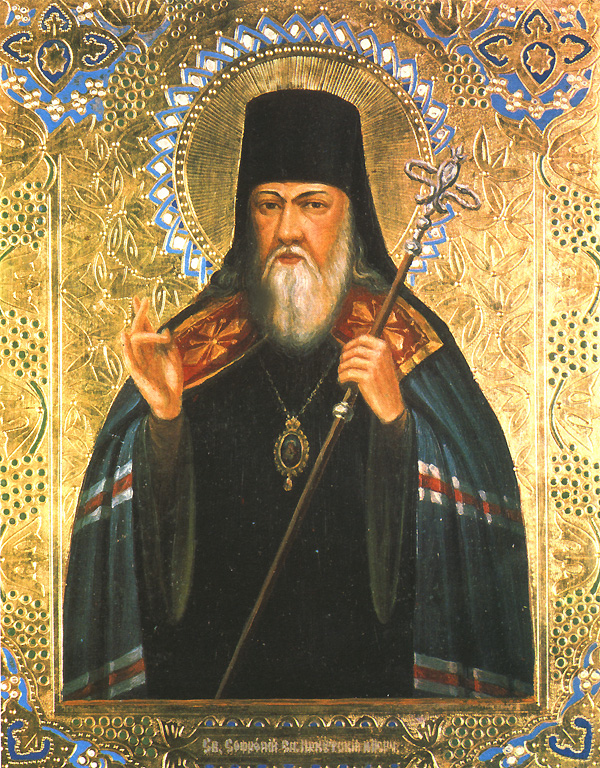
Saint ARNOUL (ARNOULT, ARNOULD, ARNULPHUS, ARNOULF), évêque de Metz en Lorraine, puis solitaire dans les forêts des Vosges (640 ou 641). (Tropaire et canon de matines à saint Arnoul et aux saints abbés des monastères vosgiens composé en français par le père Denis Guillaume et publié au tome VII du Supplément aux Ménées.)
St.
Arnold was father of Pepin and grandfather of Charlemagne. He held a
duchy in Lorraine but put this worldly prize, and riches, and married
life, behind him to pursue the life of a desert-dweller. He died to the
world and was alive unto God.
It
so happened the Bishop of Metz reposed and St. Arnold, who was known
for his holiness, was chosen as the next Bishop. The holy Bishop
maintained during his episcopate the same eremitic asceticism he had
learnt in solitude. He fasted 3 days in a row, then would eat a little
barley bread and have a little water. Under the robes of a prelate he
wore the haircloth of an ascetic.
The
Saint distributed to the poor so generously of his own possessions that
poor folk came to Metz from countries and cities afar, to receive alms
and holy counsel. His hospitality towards pious folk, pilgrims, and
monastics was legendary. He washed their feet himself, gave them new
clothing, and a little silver for the journey, and this he did not of a
season, but incessantly. All his time, he spent in vigils, fasting, and
devout prayers and talks.
One
day, when he was in a 3-day fast, he was making a procession. Many
beasts joined in the procession and prayed to God devoutly with the
Saint. And as the procession went along, a woman vexed by the Devil
began to cry out loudly. The Saint but made the sign of the Cross of
Christ over her, and she was entirely set free from the evil
one. Behold how easily the great Saints cast out the evil one, since
they had not the least trace of his wickedness remaining in them.
During
the reign of Dagobert, a leper came to the king's palace and began to
cry out for the holy man, to receive food and clothes. The Saint asked
him if he were baptised, for the man was a heathen. The leper replied he
had not found one who would impart this gift to him, whereat the Saint
baptized him. Immediately he was baptised, the leper was cleansed of his
sickness entirely, having become whole both in soul and in body.
Once
a fire was consuming the king's palace and everything round about it.
The fire threatening a little hut the
Saint had built for prayer, and wherein he was praying at the time, one
named Romancius bade the Saint leave his cell. Instead, the Saint had
himself led to the fire. There the Saint commanded all to fall upon
their faces in prayer with him. Then, raising himself up, he lifted up
his hands to heaven, and made the sign of the Cross, and the fire was
quenched. One of the brethren saw that night a fiery cross in the sky,
and a voice was heard: "By this hath Bishop Arnold delivered the city
from fire."
Thereafter
St. Arnold left the Frankish court behind, and made a little house in
the wilderness, where dwelt a few monks. He lived in contemplation and
the praises of God, and continued in that place to receive the poor and
pilgrims. He would cook for them himself, so he was both a Bishop and a
cook. Food there was
scarce, but many a time did he suffer terrible hunger and thirst, only
so that the brethren might not.
When
the time had come for the Saint's repose, after he breathed his soul
forth unto his Creator, his successor, Bishop Goericus, assembled a
great procession and came to the place where lay the body of Arnold.
There vigils were celebrated very solemnly, and then the body was borne
into the city. As they were so processing, those carrying the back part
of the bier fell into a ditch. But Angels of God sustained the body in
the air, and soon the men who had fallen caught up and resumed their
places. Next, during the same procession to the city, they would have
passed through land belonging to a lecher, whom the Saint had reproved
for his sin but who would not repent. On the edge of this man's land,
the body
of Arnold became immovable. No strength of men could force the body to
cross over the lecher's land. So a wealthy man named Noddo invited the
whole company to spend the night at his estate, and there goodly
provisions and good beer were imparted to all. The next morning with
great joy the body was borne into the city. All the people greeted their
reposed archpastor, whose body was buried in the church of the
Apostles.
A
woman long blind, named Julia, came to the tomb of St. Arnold often to
pray. She received her sight. Another woman was punished by God because
she had worked on Sunday. Her hands became instantly crippled. Then came
she to the tomb and begged the Saint to help her, weeping and praying
sincerely. Quickly she recovered the use of her hands.
The
memory of this glorious Saint is kept on the 17th of the kalends of
August (July 18) to the honour of God, Who liveth and reigneth without
end, unto ages of ages. Amen. [adapted from the Golden Legend]
Il
naquit vers 582 à Lay-Saint-Christophe, près de Nancy; son père
s'appelait Arnoald ou Buotgise, et sa mère, Oda, était fille du duc de
Souabe. Jeune encore Arnoul devint familier de Gondulf, conseiller de
Childebert II, puis entra au service de Théodebert dont il gagna la
confiance. Il fut alors chargé d'administrer les domaines royaux dans 6
comtés.
En 614, l'évêque Pappolus étant mort, Arnoul, bien que
laïc, fut choisi pour le remplacer sur le siège de Metz. Sa femme,
Doda, fille du comte de Boulogne, entra dans un monastère de
Trèves : de leurs deux fils, Anségise ou Anchise et Clodulphe, le
premier épousa une fille de Pépin de Landen et devint ainsi l'ancêtre de
Charlemagne; quant au second, connu également sous le nom de Cloud et
honoré le 8 juin, il monta sur le trône épiscopal de Metz quelques
années après son père.
Devenu évêque, Arnoul n'en garda pas
moins une grande influence politique; Clotaire II ayant rétabli pour
Dagobert un petit royaume d'Austrasie, Arnoul fut chargé de former le
jeune prince et de gouverner son État; il réussit, en 626, à réconcilier
le père et le fils qui avait réclamé un agrandissement de territoire.
Vers la même époque, il assistait au concile de Clichy, puis à celui de
Reims qui eut pour but de promulguer en Austrasie les canons du concile
tenu à Paris en 615 et confirmé par édit de Clotaire. Alliant la plus
humble vertu aux honneurs les plus éclatants, Arnoul aspirait à une vie
plus simple, vivant de préférence dans les villas du roi et songeant
même à se retirer complètement du monde. Un de ses amis, Romaric, avait
quitté depuis longtemps la cour et s'était fait ermite dans les Vosges,
en un lieu qui prit plus tard son nom, Remiremont. Arnoul aurait voulu
le rejoindre; Clotaire II empêcha son départ; dans la suite, Dagobert
fut plus violent, menaça de disgracier les fils d'Arnoul, mit même la
main à son épée, puis, calmé, demanda pardon et accorda toute liberté en
629. La charge épiscopale fut remise à Goéric, et Dagobert prit
désormais conseil de Cunibert , évêque de Cologne.
Arnoul
installa son ermitage sur une colline voisine du mont Habend où vivait
Romaric, et un pont fut jeté sur la profonde vallée qui les séparait;
ils passèrent ainsi une dizaine d'années, recevant des lépreux et les
soignant, jusqu'au jour,
16 août, où Arnoul fut prêt à retourner dans la maison du Père; il avait
prévu ce moment, demandant les prières de son compagnon "Je n'ai rien
fait de bon dans ma vie, disait-il, et je suis chargé de fautes pour
lesquelles je te prie d'implorer la clémence divine". Il s'était
pourtant fait remarquer dans toutes ses charges par son esprit de
justice, sa piété, sa charité et avait reçu, raconte-t-on, l'assurance
de son salut; un jour, traversant la Moselle, il avait jeté son anneau
dans le fleuve, demandant à Dieu que cet anneau lui fût rendu si ses
péchés lui étaient pardonnés; l'anneau fut en effet retrouvé de
nombreuses années plus tard dans les entrailles d'un poisson.
Sainte EDBURGH (EDBURGA), fille du roi anglo-saxon païen Penda, moniale à Adderbury dans le comté d'Oxford (vers 650).
Saints PAMMEGHISTOS, PAMPHODITES, PAPHNUCE, PIGON, POLEMIOS, SOZOMENE, SOTIRIKHOS et PHOTIOS, des saints "allemands" de l'île de Chypre.
Saint JEAN, métropolite de Chalcédoine, confesseur des saintes Icônes (début du IXème siècle).
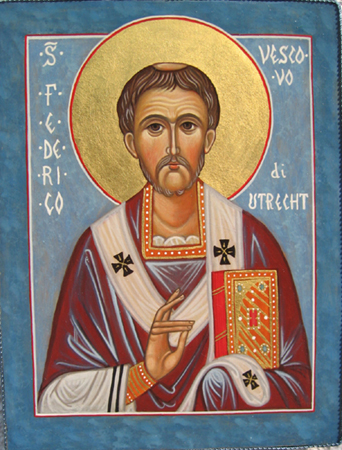
Saint FREDERIC, évêque d'Utrecht (Ultrajectum) aux Pays-Bas, martyr, assassiné vraisemblablement sur l'ordre de l'impératrice Judith de Bavière, seconde épouse de Louis le Débonnaire (838).
Di certo si sa
che intervenne al concilio di Magonza dell'829. Fu ricordato poi in una
carta del 26 dicembre 833, e nella Vita di s. Odulfo, da lui mandato ad
evangelizzare i Frisoni. Rabano Mauro gli dedicò, nell'834, il suo
commento al libro di Giosuè e scrisse un carme in suo onore.
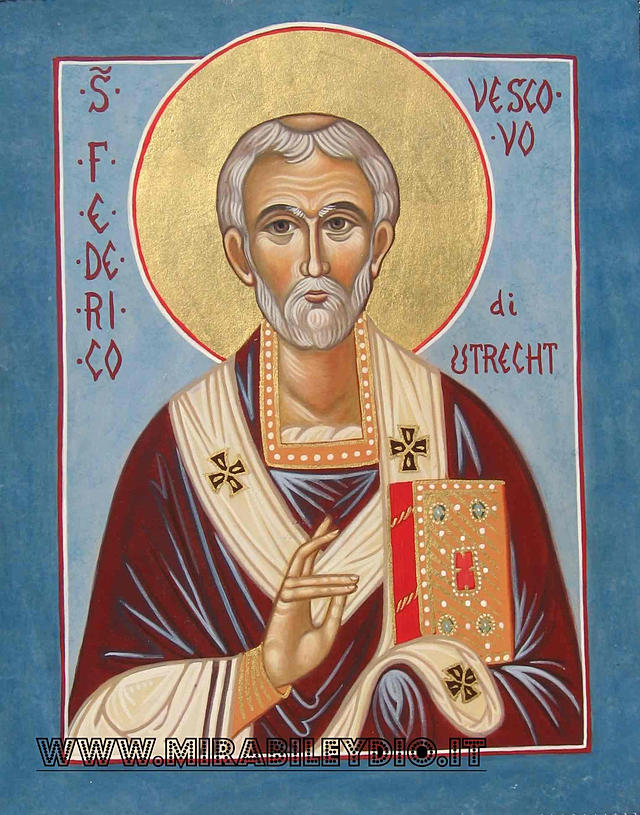
Stando alla Vita, sarebbe nato verso il 781 da famiglia probabilmente di origine inglese, non è chiaro se in Inghilterra o in Frisia. Eletto vescovo di Utrecht dopo la morte di Ricfredo, tra 1'825 e 1'828, grazie anche all'appoggio dell'imperatore Lotario, lottò contro il paganesimo, risorto in Frisia dopo l'invasione Normanna, e contro l'uso dei matrimoni incestuosi. Avendo rimproverato l'imperatore Ludovico il Pio per aver sposato, vivente ancora la prima moglie Irmingarda, Giuditta, sarebbe stato da questa fatto assassinare il 18 luglio 838. Altri però attribuiscono l'assassinio del santo ad un nobile dell'isola di Walcheren da lui rimproverato. Sepolto nella cripta della chiesa del S.mo Salvatore ad Utrecht, fu venerato come martire in diverse località dei Paesi Bassi e a Fulda.
Nel 1362 il cranio del santo, separato dal corpo dal vescovo Folkert, fu racchiuso in un reliquiario d'oro e d'argento ed esposto alla venerazione. Durante la Riforma fu salvato in una casa privata dove, secondo il bollandista G. Cuypers, era ancora conservato al principio del sec. XVIII. Del resto del corpo, invece, già al suo tempo non si sapeva più niente.
Stando alla Vita, sarebbe nato verso il 781 da famiglia probabilmente di origine inglese, non è chiaro se in Inghilterra o in Frisia. Eletto vescovo di Utrecht dopo la morte di Ricfredo, tra 1'825 e 1'828, grazie anche all'appoggio dell'imperatore Lotario, lottò contro il paganesimo, risorto in Frisia dopo l'invasione Normanna, e contro l'uso dei matrimoni incestuosi. Avendo rimproverato l'imperatore Ludovico il Pio per aver sposato, vivente ancora la prima moglie Irmingarda, Giuditta, sarebbe stato da questa fatto assassinare il 18 luglio 838. Altri però attribuiscono l'assassinio del santo ad un nobile dell'isola di Walcheren da lui rimproverato. Sepolto nella cripta della chiesa del S.mo Salvatore ad Utrecht, fu venerato come martire in diverse località dei Paesi Bassi e a Fulda.
Nel 1362 il cranio del santo, separato dal corpo dal vescovo Folkert, fu racchiuso in un reliquiario d'oro e d'argento ed esposto alla venerazione. Durante la Riforma fu salvato in una casa privata dove, secondo il bollandista G. Cuypers, era ancora conservato al principio del sec. XVIII. Del resto del corpo, invece, già al suo tempo non si sapeva più niente.
July 18th
Troparion (Tone 4)
Thou hast shown thyself, O God inspired Frederich as a guide to the Orthodox Faith, a teacher of true worship and purity, O star of the universe and companion of Bishops, O wise one. Through thy light thou hast enlightened all, O harp of the Spirit. Therefore, intercede with Christ God to save our souls.
Troparion (Tone 4)
Thou hast shown thyself, O God inspired Frederich as a guide to the Orthodox Faith, a teacher of true worship and purity, O star of the universe and companion of Bishops, O wise one. Through thy light thou hast enlightened all, O harp of the Spirit. Therefore, intercede with Christ God to save our souls.
Saint ETIENNE II, patriarche oecuménique de Constantinople (925-928).
Saint ONESIPHORE, amiral byzantin devenu ermite près d'Anarita sur l'île de Chypre.
Saint MINNBORINUS, Irlandais de nation, higoumène de Saint-Martin à Cologne en Rhénanie (986).
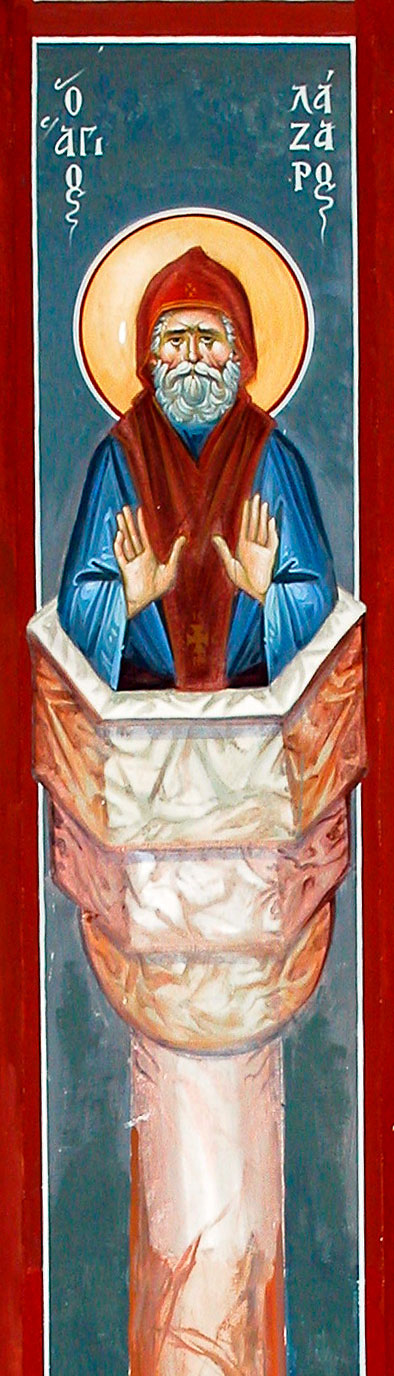
Translation des reliques de saint Lazare du Mont Galésios près d'Ephèse (+ 7 novembre 1054).
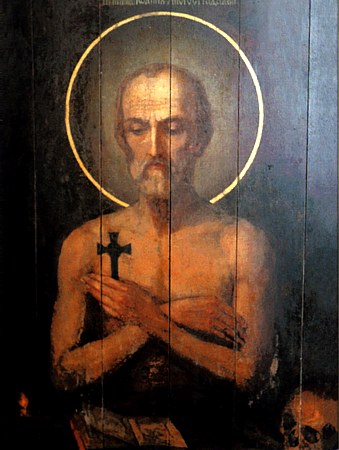
Saint JEAN l'Endurant, moine de la laure des Grottes de Kiev, athlète de la virignité (1160). (Office traduit en français par le père Denis Guillaume au tome XV du Supplément aux Ménées.)

Saint
Jean le très souffrant vécut en ascète à la Laure des Cavernes de Kiev,
acceptant nombre de souffrances pour l'amour de la virginité.
L'ascète se rappelait que dès son jeune âge, il eut à souffrir beaucoup, tourmenté par les désirs de la chair, et rien ne pouvait l'en délivrer, ni la faim, ni la soif, ni les lourdes chaines.
L'ascète se rappelait que dès son jeune âge, il eut à souffrir beaucoup, tourmenté par les désirs de la chair, et rien ne pouvait l'en délivrer, ni la faim, ni la soif, ni les lourdes chaines.
Il
entra alors dans la caverne où se trouvaient les reliques de saint
Antoine, et il pria avec ferveur le saint Abba. Après un jour et une
nuit, le très souffrant Jean entendit une voix :
"Jean! Il est nécessaire pour toi de devenir reclus, afin d'affaiblir le
tracas par le silence et l'isolement, et le Seigneur t'aidera par les
prières de Ses saints moines".
Le saint s'installa dans une caverne dès cette époque, et seulement 30 ans plus tard, il vainquit les passions de la chair.
Le saint s'installa dans une caverne dès cette époque, et seulement 30 ans plus tard, il vainquit les passions de la chair.
Rude
et violent était la lutte sur le chemin épineux que le moine dût
emprunter vers la victoire. Parfois le désir s'emparait de lui pour
abandonner sa réclusion, alors il se décidait à de plus grands efforts.
Le grand soldat du Christ creusa un trou, et avec le début du Grand
Carême, il y descendit et s'y enfouit jusqu'aux épaules, avec de la
terre. Il passa tout le Carême dans cette position, mais le feu de ses
anciennes passions ne le quitta pas. L'ennemi du Salut sema la terreur
dans l'ascète, voulant le chasser hors de la caverne : un terrible
serpent, soufflant feu et
étincelles, tenta d'avaler le saint. Ces manifestations diaboliques
durèrent plusieurs jours.
La nuit de la
Résurrection du Christ, le serpent saisit la tête du moine entre ses
dents. Alors saint Jean cria des profondeurs de son coeur : "O Seigneur
mon Dieu et mon Sauveur! Pourquoi m'as-Tu abandonné? Fais-moi
miséricorde, O seul ami du genre humain; délivre-moi de mon infecte
iniquité, afin que je ne puisse pas être pris au pière du Satanique.
Délivre-moi de la bouche de mon ennemi : envoie d'en haut un éclair de
lumière et chasse-le au loin". Soudaint, un coup de foudre éclata, et le
serpent disparu. Une lumière Divine brilla sur l'ascète, et une Voix se
fit entendre : "Jean! Voici de l'aide pour toi. Soit attentif à partir
de maintenant, que rien de pire ne t'arrive, et que tu ne souffres pas
dans les temps à venir".
Le
saint se prosterna et dit : "Seigneur! Pourquoi m'as-Tu laissé si
longtemps dans les tourments?" - "Je t'ai essayé selon la capacité de
ton endurance", fut la réponse. "J'ai mené à toi la tentation, afin que
tu puisses être purifié comme l'or. C'est aux serviteurs forts et
puissants qu'un maître assigne les travaux lourds, et les tâches faciles
aux infirmes et les faibles. Dès lors, prie celui qui est enterré ici
(Moïse le Hongrois), il peut t'aider dans ce combat, parce qu'il
accomplit de plus grandes oeuvres que Joseph le Juste". Le moine mourut
en 1160, ayant acquit la grâce contre les passions de débauche.
Ses saintes reliques reposent dans les Cavernes de saint Antoine.
On prie saint Jean pour la délivrance de l'impureté sexuelle.
Ses saintes reliques reposent dans les Cavernes de saint Antoine.
On prie saint Jean pour la délivrance de l'impureté sexuelle.
Saint PAMBO l'Obéissant, de la laure des Grottes de Kiev, qui confessa la foi orthodoxe face aux Tatars (1241).
Saint LEONCE, higoumène du monastère de Kharikov, dans la province de Novgorod (1492).

Saint CÔME (COSMAS, COSMAN), hiéromoine et scribe, martyr (Géorgie 1630).

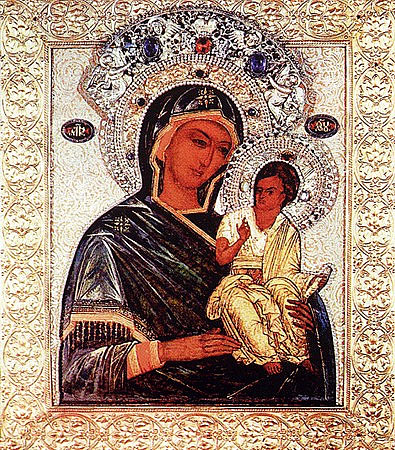
Icon of the Mother of God of Tolga
The Tolga
Icon of the Most Holy Theotokos appeared on August 8, 1314 to the Rostov
hierarch Prochorus (Tryphon in schema). Going about his diocese, the
saint visited the environs of White Lake and from there traveled along
the banks of the Rivers Sheksna and Volga, to Yaroslavl. Having stopped
with the approach of night 7 versts distant from Yaroslavl, at the right
bank of the Volga River there flows opposite into it the River Tolga.
At midnight, when everyone was asleep, the saint awoke and saw a bright light illuminating the area. The light proceeded from a fiery column on the other bank of the river, to which there stretched a bridge. Taking up his staff, the saint went across to the other bank, and having approached the fiery column, he beheld on it the icon of the Most Holy Theotokos, suspended in the air. Astonished at the miracle, the saint prayed for a long time, and when he went back, he forgot to take his staff.
The next day, after serving Matins, when St Prochorus was preparing to continue his journey by boat, they began to search for his staff, but they were not able to find it anywhere. The saint then remembered that he had forgotten his staff on the other side of the river, where he had gone across on the miraculous bridge. He then revealed what had occurred, and sent servants across on a boat to the other shore. They came back and reported that in the forest they had seen an icon of the Mother of God suspended in the branches of a tree, next to his bishop’s staff.
The saint quickly crossed over with all his retinue to the opposite shore, and he recognized the icon that had appeared to him. Then after fervent prayer before the icon, they cleared the forest at that place, and put down the foundations of a church. When the people of Yaroslavl learned of this, they came out to the indicated spot. By midday the church was already built, and in the evening the saint consecrated it in honor of the Entrance into the Temple of the Most Holy Theotokos, and having installed the icon there he established a Feast on the day of its appearance. St Prochorus later built the Tolga monastery near this church. St Prochorus died on September 7, 1328.
The Tolga Icon of the Most Holy Theotokos is also commemorated on August 8.
https://doxologia.ro/cinstirea-icoanei-maicii-domnului-de-pe-tolga-tolgska
At midnight, when everyone was asleep, the saint awoke and saw a bright light illuminating the area. The light proceeded from a fiery column on the other bank of the river, to which there stretched a bridge. Taking up his staff, the saint went across to the other bank, and having approached the fiery column, he beheld on it the icon of the Most Holy Theotokos, suspended in the air. Astonished at the miracle, the saint prayed for a long time, and when he went back, he forgot to take his staff.
The next day, after serving Matins, when St Prochorus was preparing to continue his journey by boat, they began to search for his staff, but they were not able to find it anywhere. The saint then remembered that he had forgotten his staff on the other side of the river, where he had gone across on the miraculous bridge. He then revealed what had occurred, and sent servants across on a boat to the other shore. They came back and reported that in the forest they had seen an icon of the Mother of God suspended in the branches of a tree, next to his bishop’s staff.
The saint quickly crossed over with all his retinue to the opposite shore, and he recognized the icon that had appeared to him. Then after fervent prayer before the icon, they cleared the forest at that place, and put down the foundations of a church. When the people of Yaroslavl learned of this, they came out to the indicated spot. By midday the church was already built, and in the evening the saint consecrated it in honor of the Entrance into the Temple of the Most Holy Theotokos, and having installed the icon there he established a Feast on the day of its appearance. St Prochorus later built the Tolga monastery near this church. St Prochorus died on September 7, 1328.
The Tolga Icon of the Most Holy Theotokos is also commemorated on August 8.
https://doxologia.ro/cinstirea-icoanei-maicii-domnului-de-pe-tolga-tolgska